
How to Choose a Diamond:
An Easy Guide to Selecting the Right Diamond for You
Choosing a diamond for an engagement ring or a special piece of jewellery should feel exciting, but it can quickly become overwhelming. Diamonds come with their own terminology, grading systems, certificates and price differences, which can make the process feel a little confusing at first.
This simple guide is here to help you understand the basics. Once you know what the main diamond qualities mean, it becomes much easier to choose a stone that suits your style, your budget and the piece of jewellery being made for you.
What are the 4Cs?
The 4Cs are the global standard used to grade and evaluate diamond quality. They stand for:
Carat, Clarity, Colour and Cut.
Each of the 4Cs affects the appearance and value of a diamond in a different way. Think of them as a sliding scale rather than a strict set of rules. You may prefer a slightly smaller diamond with excellent clarity, or a larger diamond with a slightly warmer colour grade. There is no single “right” choice. The best diamond is the one that works beautifully for you, your design and your budget.
What does carat weight mean?
The carat, often written as ct, is the universal measurement used to describe the weight of a diamond. One carat is equal to one fifth of a gram, or 0.20g.
Although we often think of carat as the “size” of a diamond, it is actually a measurement of weight, not diameter. This is important because two diamonds with the same visible width can still have different depths, proportions and weights.
For example, two diamonds may both measure around 4mm across, but one may be cut deeper and therefore weigh more. This is why carat weight is only one part of choosing a diamond. The way the diamond is cut and proportioned also has a big effect on how large, bright and balanced it appears.
How does diamond carat affect the price?
In simple terms, a higher carat weight usually means a higher price. Certain milestone weights, such as 1ct, can also carry a noticeable price increase. For example, a 1ct diamond will often cost significantly more than a 0.95ct diamond, even though the visual difference may be very hard to notice.
It is also worth being aware of the term total carat weight. If a ring contains multiple diamonds, the total carat weight refers to the combined weight of all the diamonds in the piece, rather than the weight of one individual stone.
How is diamond clarity graded?
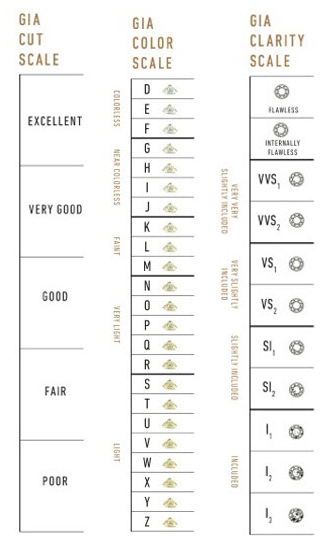
Diamond clarity refers to how clean and clear a diamond appears. Because diamonds are naturally formed, many contain tiny internal features or surface marks. These are often called inclusions and blemishes.
Some are only visible under magnification, while others may be seen with the naked eye. A diamond’s clarity grade is assessed by looking at the size, position, number and visibility of these natural characteristics. These features can affect how light travels through the stone, which may influence how bright and sparkly the diamond appears.
The clarity scale generally ranges from Included through to Flawless. As the clarity grade improves, the price can increase dramatically. However, many diamonds with small inclusions can still look beautiful to the naked eye, making clarity an area where careful selection can offer excellent value.
The colour of a diamond
When a diamond forms, trace elements and natural conditions can affect its colour. In white diamonds, the colour scale is used to assess how colourless or tinted the diamond appears.
At the top of the traditional colour scale is D, which is considered colourless. As you move further down the scale, subtle warmth or a hint of colour may become more noticeable. Around grades such as J, some diamonds may show a gentle warmth, especially when compared directly with colourless graded stones .
Fancy coloured diamonds, such as vivid yellows, pinks and blues, are graded differently. These diamonds are valued for the strength and beauty of their colour rather than how colourless they are.
How can the cut of a diamond affect its value?
Cut is one of the most important factors in how a diamond looks. It is sometimes confused with shape, such as round brilliant, princess, oval or Asscher. However, cut actually refers to how well the diamond has been crafted, proportioned and polished.
A well-cut diamond reflects light beautifully, giving it brightness, fire and sparkle. A poorly cut diamond may appear dull, even if it has good colour and clarity.
The GIA Cut Grading System for a standard round brilliant diamond evaluates several elements, including brightness, fire, scintillation, weight ratio, durability, polish and symmetry. These factors assess both the diamond’s appearance and the craftsmanship behind it.
The price difference between an excellent cut and a poor cut can be significant. However, between neighbouring grades, the difference may only be noticeable under magnification or to a trained eye.
What are conflict-free diamonds?
All diamonds supplied by the Park Road Jewellery workshop are sourced from reputable suppliers who comply with the Kimberley Process.
The Kimberley Process Certification Scheme was established to help prevent conflict diamonds from entering the mainstream diamond market. It applies to rough diamonds and is designed to support more responsible sourcing throughout the diamond supply chain.
Choosing a diamond from a trusted supplier gives you greater confidence in where your diamond has come from and allows you to shop with peace of mind.
Should I buy a diamond with a certificate?
A certified diamond comes with an independent grading report that states the individual qualities of that specific stone. This usually includes details such as carat weight, colour, clarity, cut and measurements. Many certified diamonds also have a microscopic laser inscription on the girdle of the stone, matching the certificate number.
One of the key benefits of choosing a certified diamond is that it can be very helpful for insurance purposes. The certificate gives your insurer clear, independent evidence of what the diamond is, its quality, and how it should be valued or replaced if it is lost, stolen or damaged.
A certificate can also give you added confidence when comparing diamonds, because you are not relying on appearance alone.
Choosing your diamond with Park Road Jewellery
At Park Road Jewellery, Michelle can source a variety of diamonds to suit your individual project, style and budget. Whether you are choosing a diamond for an engagement ring, a remodelled piece of jewellery, or a completely bespoke design, You can also enjoy hands-on experience choosing from a carefully selected range of diamonds chosen especially for you.
You will have the opportunity to compare carefully selected diamonds and talk through the differences between them, including carat weight, colour, clarity, cut and certification. Allowing you to choose a diamond with confidence, knowing it has been selected especially for your design.This makes the experience personal, meaningful and something to treasure long after the jewellery has been made.
Further information
Other helpful guides on this subject
A Guide to Precious Metals Used in Jewellery
A Guide to Choosing Your Wedding Rings
Book a one-one consultation with Michelle to discuss your ideas
